
By Aldo Santamaria | June 27, 2026
Leverage Constraints
It’s easy to think of limits as bothersome restrictions. I sometimes do, for example, when I can’t have my fifth piece of lemon pie without a voice in my head telling me it’s not good for my health, or when I can’t get into a concert venue without passing through a strict security check. But these examples show that limits exist for a reason: they keep things from going wrong.
In this blog post, which is part of a series about Advanced Project Finance Debt, I’ll explain how the importance of limits holds true not only in everyday life, but also when sizing debt for infrastructure and/or renewable energy projects.
How Lenders Think About Leverage Constraints
Lenders are very familiar with the benefits of setting boundaries. Some would call them pessimistic, while others would define them as “appropriately skeptical”.

Lenders may impose leverage caps on project finance assets such as wind farms. Whatever the label we put on them, they typically assess risk and limit how much capital they are willing to provide. This shows up, most importantly, in what’s known as a leverage constraint: simple, powerful, and with a direct impact on debt quantum.
We can think of leverage constraints as a blunt force tool. Rather than adjusting cashflow assumptions or fine-tuning metrics like DSCR, lenders can impose a hard cap on debt relative to project cost.
When Debt Capacity Meets Boundaries
Imagine a wind farm project with a total cost of $100m. Equity is asking lenders to provide as much debt as possible. Both parties naturally ask: how much can the project borrow?
The answer lies in two independent limits: one is driven by project performance, while the other reflects lender risk appetite. And if there’s one main takeaway from this post, it’s that lenders don’t size debt to the most optimistic scenario, but to the most restrictive one. So, let’s look at both limits and see whether they are as restrictive as my personal four pieces of lemon pie per day rule.
Cashflow-based limit
This is the most fundamental constraint. How much can the project afford to repay?
Remember: in project finance, lenders don’t get guarantees in the form of traditional collateral; repayment must rely entirely on future operational cashflows, which directly determine the amount lenders are willing to provide.
Back to our wind farm. Let’s say we run the analysis, and it shows the project can repay an $80m loan. On the surface, this seems straightforward. But lenders are not only concerned about repayment capacity. They tend to focus on mitigating risk, and that’s the reason why they introduce a second limit.
Leverage-based limit
.We can define this one as: Debt / Total Project Cost. Lenders typically impose it as a leverage ratio, such as 60%.
Sounds like a bothersome restriction? Maybe, but remember how I shouldn’t eat insane amounts of lemon pie even if I absolutely adore it. From a lender’s perspective, the leverage-based limit serves as a safeguard. It’s a way to manage risks that cashflow models don’t fully capture. This includes construction delays, cost overruns, uncertainty in future cashflows, and even the need for equity to have “skin in the game”.
This leads to a different question: “Even if the project can repay more, how much debt are we willing to allow relative to its cost?” If our sample wind project costs $100m in total, and our maximum leverage is 60%, then the maximum allowed debt would be $60m, even if the cashflow analysis showed it could pay an $80m loan.
In other words: Project debt = min(cashflow capacity, leverage capacity)
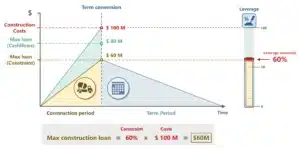
Leverage Constraints can restrict debt below what project cashflows could otherwise support.
When Leverage Constraints Start to Bind
When cashflow-based and leverage-based limits don’t match, equity has several options.
In our wind farm project, the project’s cashflows can theoretically support $80m, but lenders cap debt at $60m. This creates tension, and now equity is the party facing a different question: “How do we structure financing given we can’t borrow the full amount?”
There are a few common approaches, and each reflects a different trade-off between lender protection and equity returns.
True-up / catching up later
The first approach would be for equity to accept the constraint initially and revisit it later. During construction, debt is capped at $60m, but after completion, the project raises $20m more to bring total debt to $80m, supported by operational cashflows.
This works because leverage constraints are generally applied to the construction loan, rather than the term loan, which only comes into effect once the project is operating
Overfund / equity steps in earlier
Another option is for equity to contribute more capital upfront. This increases total funding temporarily, allowing the same leverage percentage to translate into a higher amount of debt in dollars.
For example, we’ve seen that our wind project could theoretically support $80m from cashflows. If total funding during construction increases to $133.3m, then 60% of that total equals $80m. Here, equity contributes $53.3m. This allows the project to reach that higher debt level while staying within leverage limits.
Downsizing / accept lower debt
Finally, the simplest option would be to accept this constraint and reduce debt permanently to $60m. From a lender’s perspective, this is clean and conservative. From equity’s perspective, not so much.
This has real financial consequences. Less debt means equity must contribute more capital, while overall cashflows remain broadly the same. At the same time, equity may receive fewer distributions during the earlier years, as more cash goes to debt service.
The result: returns are spread over a larger investment amount and shifted further into the future, which leads to a lower IRR.[
Training with Pivotal180
We cover this topic in our Leverage Constraints mini-course and in the Advanced Project Finance Debt course, which builds on our general project finance modeling courses, and includes many other topics, such as blended DSCR debt sizing, P90 sweeps, junior debt, refinancing, and multi-tranche debt.
Pivotal180’s project finance modeling courses are designed to familiarize anyone, from analysts to the C-suite, with the knowledge and skills to build, analyze and communicate clearly about project finance models:
Course participants will learn how risk is allocated between lenders and sponsors, understand the structure and drivers of project finance transactions, and gain the necessary skills to run and evaluate operational or financing scenarios required to identify the most substantial risks and opportunities for any deal.
For readers looking to move from concept to application, Pivotal180 offers practical courses in Project Finance Modeling, as well as industry-specific programs covering areas such as battery storage and mining, with a focus on real-world deals.
Come model with us!
